Price or SAC — how Brazilian mortgages really differ
Same loan, same rate, and a R$ 269k difference in total interest. Where it comes from, and when each system makes sense.
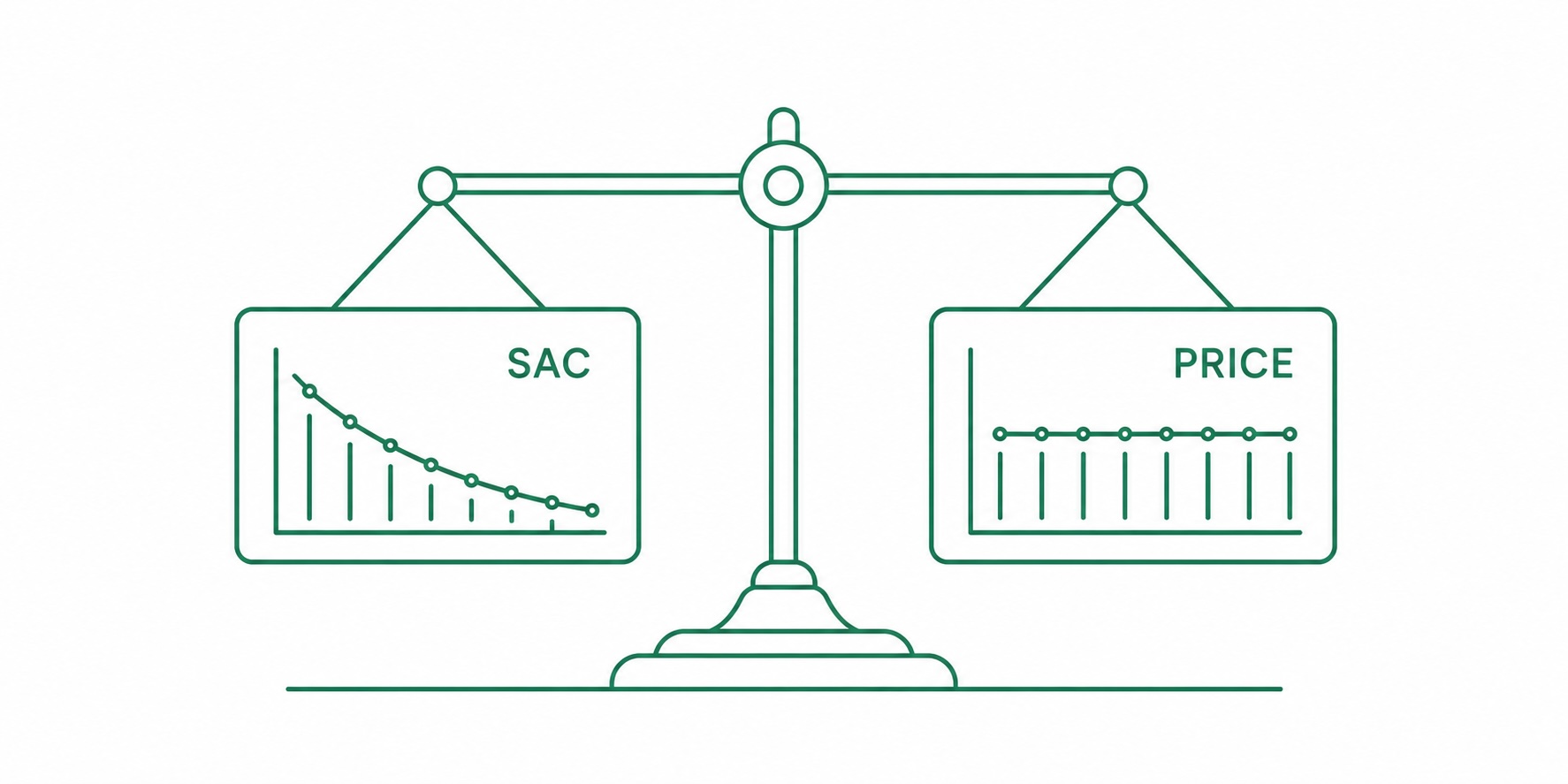
If you finance a property in Brazil, you choose — often without noticing — between two amortization systems: the Price table and SAC. Both charge the same interest rate on the same debt. What changes is when you pay back the principal, and that changes everything else.
A US fixed-rate mortgage works like Price: a constant payment that is mostly interest at the start. SAC has no common US equivalent.
The example
R$ 300,000 financed over 360 months at 1% per month. Same numbers for both systems.
| Price | SAC | |
|---|---|---|
| First payment | R$ 3,085.84 | R$ 3,833.33 |
| Last payment | R$ 3,085.84 | R$ 841.67 |
| Total interest paid | R$ 810,901.60 | R$ 541,500.00 |
| Balance after 5 years | R$ 292,989.66 | R$ 250,000.00 |
Price: fixed payment, slow principal
With Price the payment never changes. Early on, almost all of it is interest: in the first month, of R$ 3,085.84, R$ 3,000.00 is interest and only R$ 85.84 reduces the debt. After five years of payments you still owe 97.7% of what you borrowed.
That is why Price looks cheaper — the first payment is smaller — and ends up costing more: the principal stays with you longer, and interest is charged on whatever principal you still owe.
SAC: fixed amortization, falling payment
With SAC the fixed part is the amortization: R$ 833.33 every month. Interest is charged on a balance that falls every month, so the payment falls with it. The first payment is the heaviest (R$ 3,833.33); from month 91 it is already below the Price payment, and it ends at R$ 841.67.
Which one to choose
- SAC if the first payment fits your budget comfortably. You pay less interest overall and the balance drops fast — which matters if you might sell, pay off or move halfway through.
- Price if the first SAC payment is a squeeze. A smaller, predictable payment can be the difference between keeping your emergency fund and not.
The right question isn't "which one is cheaper", it's "which first payment can I make without net worth becoming the shock absorber".
Either way, extra payments change the math: every extra real paid early stops accruing interest for the rest of the contract. In 12true that is an extra amortization on the commitment — and the effect on the term or the payment shows up immediately.