Pay yourself before anything else
How much to set aside, on which day, where to send it — and what to do when your income changes every month. A practical guide to treating your own future as the first bill.
"Pay yourself first" is old advice, and almost everyone agrees with it. What's missing isn't conviction, it's mechanics: an amount, a date and a destination, all set before the month begins. Without them, the intention turns into "if anything's left", and there rarely is.
1. Set an amount, not an intention
Start with a percentage of your take-home pay and turn it into dollars. With $6,000 take-home, 15% is $900 a month. The exact number matters less than its existing at all — going from 10% to 15% is easier than starting from zero.
If 15% feels impossible today, start with what fits and add a point with every raise. A raise that reaches your lifestyle before it reaches your savings never comes back.
2. Pay on the day the money arrives
The contribution leaves on payday, not at the end of the month. At the end of the month it competes with everything that happened in between; at the start, it's already gone.
- Schedule a recurring transfer for the day after your paycheck lands.
- If your employer offers it, contribute to a 401(k) through payroll — the money never touches your checking account.
The goal is for saving not to depend on remembering, or on deciding again every month.
3. Send it somewhere other than your everyday account
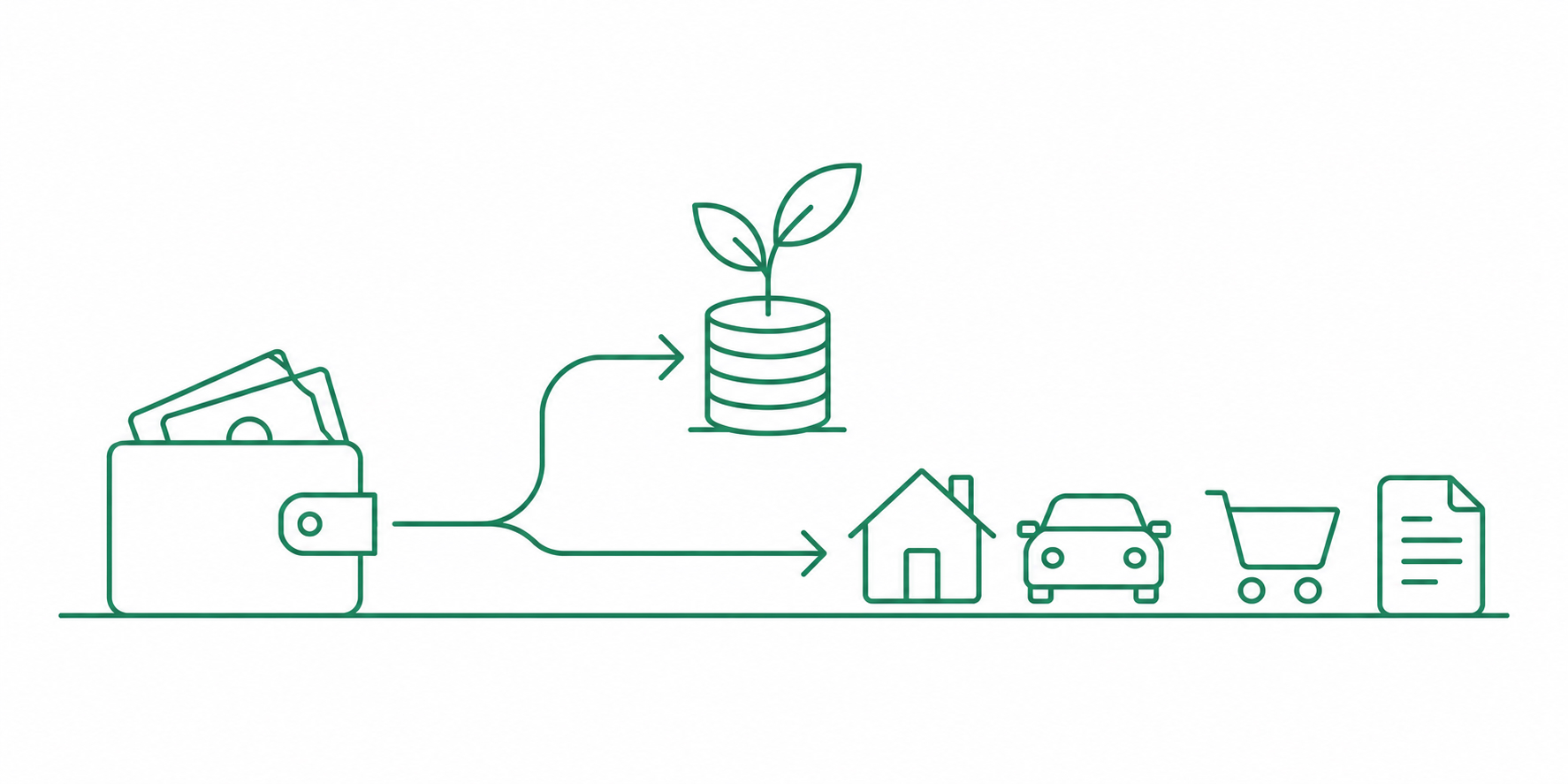
Money sitting in checking is spending waiting to happen. The contribution goes to a separate, named account:
- Emergency fund first — six months of living costs, somewhere you can reach the same day, like a high-yield savings account.
- Dated goals next — a down payment, a car replacement.
- Long term last — retirement and net worth you don't touch.
With living costs of $4,500 a month, a six-month fund is $27,000. At $900 a month, that's 30 months to fill it. Knowing the timeline turns "I'm saving" into "eleven months to go".
4. Variable income: contribute for the bad month
If you're self-employed, on commission, or paid in another currency with a moving exchange rate, there's no fixed paycheck to deduct from. The rule changes shape, not principle:
- The fixed contribution is based on your worst month of the last twelve, not the average.
- In good months, whatever is above that floor is split by rule: half to the contribution, half to the month.
That way the commitment survives the weak month, and the strong month doesn't quietly become your new lifestyle.
5. When you need to withdraw
It will happen. What matters is how. Drawing on the emergency fund for a real emergency is exactly what it's for — but it should be a decision with a name and an amount, recorded, not a silent transfer back into checking.
Paying yourself first isn't about never touching what you saved. It's about only touching it knowing that you did.
In 12true, the contribution is a commitment with a date, like rent, and a withdrawal shows up as a withdrawal — it doesn't vanish into the balance.