FBAR: the form for anyone living in the US with an account in Brazil
If your accounts outside the US added up to more than $10,000 on any day of the year, the US government wants to know. What the FBAR is, who files it, how to do the math, and why forgetting it is expensive.
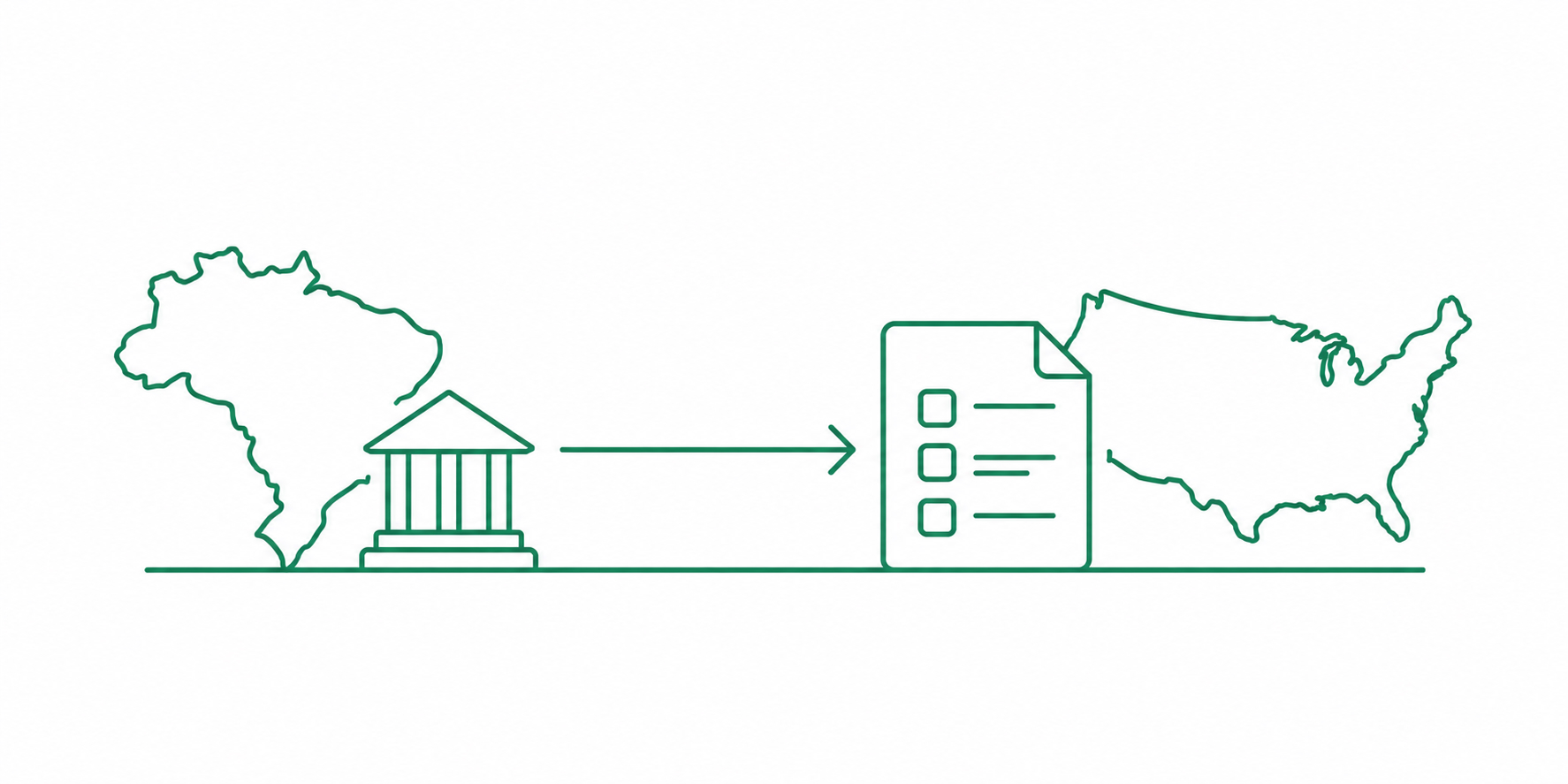
People who move to the United States rarely close their Brazilian accounts. The checking account stays open to pay what was left behind, along with the savings account, the CDB, the brokerage. To the US government, these have a name: foreign financial accounts. Above a certain amount, they must be reported every year on a form of their own: the FBAR.
It is not a tax. Filing it costs nothing and does not change what you owe. But forgetting to file is one of the most expensive mistakes a Brazilian living in the US can make.
What it is
FBAR stands for Report of Foreign Bank and Financial Accounts. Its official name is FinCEN Form 114. It does not go to the IRS: it goes to FinCEN, the Treasury bureau that fights financial crime, through its own online system. It is not filed with your income tax return.
The form only reports: which accounts you have outside the US, where they are, and the highest balance each one reached during the year. There is no tax to compute on it.
Who has to file
Two conditions, both at once:
- You are a US person. For the FBAR, that includes US citizens, green card holders and residents under the substantial presence test (days spent in the US). US companies, trusts and estates are included too.
- Your foreign accounts added up to more than $10,000 at some point during the year. Not the December 31 balance. It is the highest value of each account during the year, added together.
The detail that catches most people: you add up the peaks, even if they happened on different days. And once you cross the threshold, you report every account, small ones included.
It does not matter whether the account earned interest, sat idle, or only held money in transit. The question is whether the account existed and how high it went.
The math, with numbers
A green card holder kept these accounts in Brazil during the year:
| Account | Highest balance in the year |
|---|---|
| Checking account | R$ 32,000 (in July) |
| CDB at the same bank | R$ 28,000 (in March) |
| Sum of the peaks | R$ 60,000 |
Converted at the US Treasury rate for December 31 (say R$ 5.50 per dollar, just for the example), that is $10,909. It is over $10,000: the FBAR is required, and both accounts go on it.
Note that on no single day did the two accounts hold R$ 60,000 together. It does not matter. What gets added is the peak of each one.
Getting the number right
- The highest balance of each account, in the account's currency, from the year's statements. A reasonable approximation based on statements is accepted.
- The conversion uses the US Treasury's official rate for the last day of the year — not the rate on the day of the peak, and not your bank's rate.
- Keep the records for five years: account name and number, bank name and address, account type and the highest value of the year.
What counts and what doesn't
Counts:
- checking and savings accounts;
- CDBs and other investments held at a bank;
- brokerage accounts — the account is reported, not each security in it;
- Brazilian investment funds (foreign, from the US point of view);
- life insurance or annuities with a cash value;
- accounts you only have signature authority over.
Doesn't count:
- real estate in your name, in Brazil or anywhere else;
- cash kept at home;
- stocks or bonds held outside a financial account;
- US funds that invest abroad;
- government social security benefits, such as Brazil's INSS;
- an account at a foreign bank's branch inside the US.
Brazilian private pension plans (PGBL and VGBL) are the case that divides accountants the most. When in doubt, the safer rule is to report — and confirm with whoever signs your return.
Joint accounts
Each owner reports the full balance of a joint account, not their share. A R$ 60,000 account held with a spouse counts as R$ 60,000 on each spouse's FBAR.
A couple can file a single FBAR only when all of one spouse's accounts are held jointly with the other. Both spouses sign FinCEN Form 114a, which you keep and do not file. If either spouse has any account of their own, each files separately.
Deadline and where to file
- Due April 15 of the following year, with an automatic extension to October 15. No request needed.
- Where: FinCEN's BSA E-Filing System, online, with no registration and no fee.
- It does not go with your income tax return. Even if a CPA prepares your return, confirm that they also filed the FBAR.
Why it matters so much
Because the penalty is out of proportion to the oversight.
- Non-willful (you didn't know, you forgot): up to $10,000 per report, an amount the law adjusts for inflation every year. In 2023 the US Supreme Court ruled that this penalty applies per report not filed, not per account. Before that, the government had assessed it per account, which multiplied the total.
- Willful: the greater of $100,000 or 50% of the account balance, also adjusted for inflation, plus possible criminal prosecution.
And it does not depend only on your memory. Brazil and the United States have an information-sharing agreement (FATCA): Brazilian banks identify account holders who are US persons and report their accounts.
I forgot to file. Now what?
There is a way back. FinCEN and the IRS have procedures for people who missed the FBAR — with better treatment for those who come forward before being contacted, and when there is no unreported income involved. The official guidance is on FinCEN's late filing page.
This is the case where it pays to see a CPA or tax attorney before filing anything: the procedure you choose changes the outcome.
The FBAR is not Form 8938
They are two different forms, and many people need both:
| FBAR | Form 8938 | |
|---|---|---|
| Filed with | FinCEN | IRS, with the return |
| Threshold | $10k | from $50k |
| Covers | financial accounts | accounts and other assets |
The 8938 threshold depends on filing status and where you live: for a single filer living in the US, it is $50,000 at year end or $75,000 at any time. Filing one does not excuse the other. And the US return itself asks, on Schedule B, whether you have a foreign account.
Official sources
- FinCEN — Report Foreign Bank and Financial Accounts
- IRS — Report of Foreign Bank and Financial Accounts (FBAR)
- IRS — Comparison of Form 8938 and FBAR requirements
- BSA E-Filing System — FBAR filing for individuals
- US Treasury Reporting Rates of Exchange
Checked in October 2026 against FinCEN and IRS pages. Thresholds, deadlines and penalties are reviewed every year — check the sources above before filing.
And in 12true
The tedious part of the FBAR is finding each account's peak for the year and converting it at the right rate. In 12true, every account already has a country, a currency and a holder, and each day's balance comes from the recorded entries. The Tax obligations panel will use that to tell you when an FBAR is likely, with the math done and the accounts that went into it, so you can check it with your CPA.